Showing posts with label DMIS ("Developmental Model of Intercultural Sensitivity"). Show all posts

Saturday, May 28, 2011

Does the Bible Support (should Christians embrace) Ethnorelativism?

I think it’s worth asking the question of whether the Bible supports Ethnorelativism, because people of faith tend to be skeptical about “secular” models, and about the concept of “relativism.”

This time, I would like to reflect from a different angle, asking whether New Testament teaching supports Bennett’s Ethnorelative stages of Acceptance and Adaptation.

(1) Acceptance

It seems to me (from personal experience and observation) that there is (or can be) a tension between faith conviction, and accepting those who are different. I suppose the tension comes partly because in talking about faith in God, we are in the realm of seeking to know and live by truth, which connects with the idea of living in the “right” way. But what easily happens, it seems, is that we handle our understanding of truth in an ego-centric and ethno-centric way – i.e., we begin to act as if we are “the people,” we are “right” and everyone else is wrong, we are “better,” etc. I’m not saying that all people of faith act like that toward everyone, or all the time, but that it’s a tendency I’ve noticed, and a danger that we need to be aware of.

My point is, there seems to be some reaction against or tension between having truth convictions, and the idea that we should accept other people.

The Teachings of the New Testament
Which is what leads me to ask, does the New Testament encourage us to accept people who are different?

Consider these verses:

Accept one another, then, just as Christ accepted you… (Romans 15:7)

Show proper respect to everyone… (1 Peter 2:17)

If it is possible, as far as it depends on you, live at peace with everyone. (Romans 12:18)

Be devoted to one another in love. Honor one another above yourselves. (Romans 12:10)

Live in harmony with one another. Do not be proud, but be willing to associate with people of low position. Do not think you are superior. (Romans 12:16)

Therefore let us stop passing judgment on one another. (Romans 14:13)

All of you, clothe yourselves with humility toward one another, because, "God opposes the proud but shows favor to the humble and oppressed." (1 Peter 5:5)

Dear friends, let us love one another, for love comes from God. Everyone who loves has been born of God and knows God. (1 John 4:7)

At the top of this list are commands to accept and to respect others. These are traits that Bennett lists prominently as characterizing the ethnorelative stage of Acceptance.

Note some of the other statements: “honor one another”; “live in harmony”; “do not think you are superior”; “stop passing judgment”; “live in peace”; “bear with each other”; “love one another.” All of these traits are central to accepting others who are different. If we practice them, we will be growing in acceptance. And I would argue that accepting others, in their differences – letting them be themselves, not trying to force them into my mold – would be central to living out what Jesus said is the overarching command, to “love our neighbors as ourselves.”

But a question arises in my mind, as I reflect on these and other New Testament teachings about relationship. Who is the “one another” referring to? Is it referring to others who are members of the family of those who believe in Jesus? Given that much of the New Testament was written to groups of Christians, and is teaching how they should relate to each other in community, it seems reasonable to conclude that this is the main emphasis. But where would this leave us (believers in Jesus) in relationship to outsiders? Do we owe them acceptance and respect, too?

The 1 Peter 2:17 reference exhorts believers to “show proper respect to everyone,” which is broadly inclusive.

In Romans 13:7 we are encouraged to “Give everyone what you owe him: If you owe taxes, pay taxes; if revenue, then revenue; if respect, then respect; if honor, then honor.” I would argue that the Bible teaches that all men and women are created in the image of God, and worthy of respect as such.

In 1 Corinthians 5:12-13 it says, “What business is it of mine to judge those outside the church? … God will judge those outside.” The Bible teaches that judgment belongs to God, not to us; and by implication, we should treat others as given freedom of choice by God, with God alone holding them accountable for their choices. Whether we agree with others or not, we owe them respect.

Jesus illustrates the command to “love our neighbor as ourselves” by using the example of a despised Samaritan, who Jews viewed as half-breed idolaters. Not to mention the fact that he even commanded us to “love our enemies.” And given that love includes accepting and respecting others, it seems easy enough to extend this teaching to cover accepting people in their cultural difference.

Finally, Galatians 6:10 exhorts us, “Therefore, as we have opportunity, let us do good to all people…” I hope it is obvious, given what I have previously written on Ethnorelativism, that accepting and adapting to difference is a form of “doing good” to others.

Beyond those specific teachings, I would look to the example of Jesus, and to the Jewish-Gentile issue regarding how to properly follow Jesus.

The Example of Jesus
Did Jesus accept different others? I would say so. Take, for example, his encounter with the Samaritan woman (John 4). Not only did he pass through Samaria (Jews would take the long way around, because they despised the Samaritans); he talked with a woman… Not only did he talk with a woman; he accepted her – talking with her, in itself, was a way of showing acceptance. And in talking with her, he didn’t focus on her culture, ethnicity, or religion (all of which, the Jews of his day looked down upon), or to try to get her to abandon her religion to become Jewish; rather, he sought to draw her attention to God, and how to truly worship. But by truly worshiping God, he did not mean, “do it my way, our way, the Jewish way, and not your corrupt, inadequate Samaritan way” – rather, he changed the focus away from the Jewish way vs. the Samaritan way, regarding the outward form of worship, declaring,

… a time is coming when you will worship the Father neither on this mountain nor in Jerusalem.  … a time is coming and has now come when the true worshipers will worship the Father in spirit and truth, for they are the kind of worshipers the Father seeks. God is spirit, and his worshipers must worship in spirit and in truth.
(John 4:21, 23-24)

Jews and Gentiles
Take, as a final example, the case of Gentiles coming to faith in Jesus (Acts 10 and following). At the time, the Jews who had come to believe in Jesus as the Messiah, thought that He was Messiah (life-giver, savior) only for the Jewish people. They still saw the Gentiles as outsiders, far from God, unclean, etc. Then God sent Peter to the house of Cornelius, over his objections; Peter told Cornelius and his household about Jesus; and the Holy Spirit “fell” on them – they were given life, “saved,” if you will, to the amazement of Peter and his fellow Jews.

Immediately, once the Jewish followers of Jesus saw that Gentiles, too, could know Jesus as the Messiah and receive life through him, they decided that to rightly follow Jesus, the Gentiles needed to be circumcised and follow the Law of Moses.

There arose a controversy over this, a meeting was held (Acts 15) between the leaders of the church and the apostles (Paul and others), and it was decided that Gentiles did not need to “become Jewish,” i.e., be circumcised and follow the Law of Moses, in order to know life through Jesus.

I would argue that what we see here, among other things, is that God “accepted” the Gentiles, as Gentiles – Peter himself said to Cornelius that he had learned from God that “God does not show favoritism but accepts people from every nation who fear him and do what is right” (Acts 10:34-35) – and commanded his people to do the same, stating that they did not need to outwardly change to become culturally or religiously Jewish, in order to be acceptable to God.

The clear message, in my opinion, is that we also should be people who accept others as they are, who do not try to change them outwardly to conform to our image of being human (including our ways of responding to God), but who embrace them as fellow human beings, created in God’s image and loved by Him (however different they may be).

(2) Adaptation

I would argue that the New Testament commands to love our neighbors as ourselves, and to do good to all people, should lead us to seek to adapt to them in their cultural difference – to enter into their world, seek to see life from their point of view (to empathize), and to live in a way that does not cause unnecessary offense. I see this approach to people rooted in the examples of Jesus and the Apostle Paul.

The Example of Jesus – the Incarnation
Jesus is the supreme example of love in the Bible; and I would characterize the Incarnation as the ultimate example of adaptation.

We are told, about Jesus:
In the beginning was the Word, and the Word was with God, and the Word was God. He was with God in the beginning. Through him all things were made; without him nothing was made that has been made. In him was life, and that life was the light of men. (John 1:1-4)

The Word became flesh and made his dwelling among us. We have seen his glory, the glory of the One and Only, who came from the Father, full of grace and truth.  (John 1:14)

Your attitude should be the same as that of Christ Jesus: Who, being in very nature God, did not consider equality with God something to be grasped, but made himself nothing, taking the very nature of a servant, being made in human likeness. And being found in appearance as a man, he humbled himself and became obedient to death— even death on a cross! (Philippians 2:5-8)

We are told that Jesus is the Word of God, one with the Father, the source of life and light – and that in the Incarnation the Divine essence took on human flesh, entered into our (human) life, so that we could be touched by the life of God.  Because of love, Jesus left his position, “made himself nothing,” came into the human setting as a Jew in First Century Palestine, was born as a baby, learned language, and grew up in a particular sociocultural setting, adapting the cultural practices and living within the religious and political context of the day.

I cannot think of a greater example of adaptation, than this. And Jesus said to his followers, “as the Father has sent me, I am sending you” (John 20:21).

The Example of Paul – “all things to all people”
The next great example I see of adaptation is that of the Apostle Paul. Consider his teaching and example:

Everything is permissible"—but not everything is beneficial. "Everything is permissible"—but not everything is constructive. Nobody should seek his own good, but the good of others. Eat anything sold in the meat market without raising questions of conscience, for, "The earth is the Lord's, and everything in it." If some unbeliever invites you to a meal and you want to go, eat whatever is put before you without raising questions of conscience. But if anyone says to you, "This has been offered in sacrifice," then do not eat it, both for the sake of the man who told you and for conscience' sake—the other man's conscience, I mean, not yours. For why should my freedom be judged by another's conscience? If I take part in the meal with thankfulness, why am I denounced because of something I thank God for?

So whether you eat or drink or whatever you do, do it all for the glory of God. Do not cause anyone to stumble, whether Jews, Greeks or the church of God—even as I try to please everybody in every way. For I am not seeking my own good but the good of many, so that they may be saved.
(1 Corinthians 10:23-33)

The key points, in Paul’s teaching (here and elsewhere):
  • he, and other followers of Jesus, are free;
  • this freedom includes the freedom to eat or drink anything, and by implication, to adapt to different situations and circumstances (Paul taught elsewhere that “in Christ Jesus neither circumcision nor uncircumcision has any value. The only thing that counts is faith expressing itself through love.” [Galatians 5:6] and “Neither circumcision nor uncircumcision means anything; what counts is a new creation.” [Galatians 6:15]);
  • the principle to not cause anyone to stumble, goes even further – the point of adaptation is to not cause a roadblock to people knowing Jesus, through the outward patterns of living (forms, traditions, etc.) – and the “Jews, Greeks or the church of God” is comprehensive, covering religious people, irreligious people, and other Christians;
  • Paul’s motivation is that people would come to know and receive life through Jesus; he advocated any outward adaptation that would facilitate this.

This is taken even further in another passage:

Though I am free and belong to no man, I make myself a slave to everyone, to win as many as possible. To the Jews I became like a Jew, to win the Jews. To those under the law I became like one under the law (though I myself am not under the law), so as to win those under the law. To those not having the law I became like one not having the law (though I am not free from God's law but am under Christ's law), so as to win those not having the law. To the weak I became weak, to win the weak. I have become all things to all men so that by all possible means I might save some.
(1 Corinthians 9:19-22)

When Paul is talking about “winning” people, he is not talking about converting them from one religion to another; i.e., he is not talking about “winning” them to “Christianity” (which did not exist as a concept then) or to Judaism. He is clearly talking about “winning” them to Jesus Himself, to life in God (through Jesus). And for this, he felt free to adapt in outward practices (which I would call, “cultural” practices) – eating, drinking, circumcision (or not), following the Jewish religious law (or not), etc.

In a famous example of adaptation, Paul when speaking in Athens at the Areopagus, quoted pagan writers and referred to an altar “to an unknown god,” in looking for ways to make his message about Jesus understandable in their frame of reference (Acts 17:18-34).

There are plenty of New Testament teachings, as well, that clearly state that outward forms are not essential, from God’s perspective – these include circumcision (central to the Jewish law and custom), keeping one day as the/a Sabbath, food and drink, and other practices.

I would conclude, therefore, that we should adapt to others based on the law of love (the highest law binding and guiding followers of Jesus); that we are free to do so, based on the example of Jesus, the example of Paul, and the rest of the New Testament teaching about essence and outward form; and that we are exhorted to, based on Paul’s teaching and example, for the sake of people coming to know Jesus as their life (but not for the sake of converting them in outward form to our way of life, our way of following Jesus, or our religion).

As a follower of Jesus, I not only do not see a problem with embracing a goal of intercultural sensitivity (becoming ethnorelative); for me, my faith demands that I seek to grow in this direction.

Friday, May 27, 2011

Culture Quote of the Day - the basis for ethical choices

“The third assumption of this model [the “Developmental Model of Intercultural Sensitivity”] is that ethical choices can and must be made for intercultural sensitivity to develop. However, these choices cannot be based on either absolute or universal principles. Rather, ethical behavior must be chosen with awareness that different viable actions are possible.”
Milton Bennett, “Towards Ethnorelativism”

So how does this fit with Bennett’s idea of developing a “meta-ethic” (based on “life itself”)? Isn’t he saying, here, that ethics are only and totally rooted in a sociocultural context?

How do I as a person of faith in God, respond to this statement?

To a certain extent, I agree with Bennett. I think he’s probably right that if you take a wide spectrum of people, from different cultural backgrounds, you will not be able to reach agreement on “universal” ethical principles. One dividing line is that between people who believe in God and those who don’t. Those who don’t, admit that they have no “absolute” or outside-a-human-context basis for ethical values, whereas those who do, believe that there are ethical values rooted in the existence and nature of God. (I think that among people who do believe in God, it may be possible to come to some agreement on “universal” ethical principles.) To talk about ethical choices, among people who are from different backgrounds, we must take into account the fact that we will have different perspectives based on our different backgrounds.

On the other hand, I believe that a person can be ethnorelative / interculturally sensitive, and believe in ethical values that are rooted outside of human culture, e.g., in the existence and nature of God. Jesus, for example, taught that the guiding principle of life is love – love of God and love of neighbor. If God exists, and if Jesus came from God, that would be an “absolute” or “universal” principle, whether people recognized it as such or not (though how it is worked out, would depend on the context, and would be shaped by worldview, culture, etc.).

In other words, I don’t believe it is an either/or choice – either you accept cultural difference, an ethnorelative perspective, and Bennett’s model of intercultural sensitivity, or you believe that ethical values and choices can be rooted in absolute principles. For Bennett to insist on this choice, is to extend his model beyond its limits (and he himself points out, at the end of the article, that there is growth beyond the model, and that the model itself is only one more construction of reality).

Sunday, May 22, 2011

Is Ethnorelativism Compatible With Faith?

It is time to address an underlying question that arises for people who believe in God, regarding Milton Bennett’s "Developmental Model of Intercultural Sensitivity" (DMIS) that I have been reflecting on. The question could be framed in different ways:

Are people of religious faith bound to be ethnocentric?
Are people of religious faith bound to reject ethnorelativism / Bennett’s model?
Is faith compatible with ethnorelativism (and vice versa)?

I will look at several statements from Bennett’s “Towards Ethnorelativism,” and attempt to address these fundamental questions. I do so for myself as a person who is both an Anthropologist, and as such, committed to understanding culture and growing in intercultural sensitivity and competence, and as a “Christian,” a person who believes in the New Testament teaching that Jesus is the incarnate Word of God and the source of life to all who receive him. So in a way, for me the question is, can my faith in Jesus be reconciled with my Anthropology? But I offer these reflections for people of any religious faith, be they Christians, Muslims, Jews, or any other. I think the issue is common for all of us.

Bennett’s statements, which I want to consider:

“The ethnocentrism of transcendent universalism is nevertheless evident. The principle or supernatural force assumed to overlie cultural difference is invariably derived from one’s own worldview. I have yet to hear anyone at this stage say, ‘There is a single truth in the universe, and it is not what I believe.’ [emphasis mine]

“A more pernicious manifestation of ethnocentrism based on transcendent universalism is derived from any of a variety of aggressive conversion activities. Whether the conversion sought in another culture is religious, political, or economic, it rests on the assumption that there is a single truth, or best way, and that with sufficient education all people will discover this truth within themselves. These overtly ethnocentric conversion efforts may be accompanied by a high degree of interest in cultural difference, perhaps with the rationale that knowledge of difference is necessary to implement conversion effectively.” [emphasis mine]

“Fundamental to ethnorelativism is the assumption that cultures can only be understood relative to one another and that particular behavior can only be understood within a cultural context. There is no absolute standard of rightness or ‘goodness’ that can be applied to cultural behavior. Cultural difference is neither good nor bad, it is just different… One’s own culture is not any more central to reality than any other culture….” [emphasis mine]

“a state of ethnorelativism does not imply an ethical agreement with all difference nor a disavowal of stating (and acting upon) a preference for one worldview over another. The position does imply, however, that ethical choices will be made on grounds other than the ethnocentric protection of one’s own worldview or in the name of absolute principles.” [emphasis mine]

I think that Bennett is guilty of reducing everything to an outworking of culture (though I would like to talk with him face to face about this, to see if I am understanding him correctly). In my view, Anthropologists who do this, especially when talking about matters of faith/religion, tend to do so because of imposing their own secular worldview on reality, and on others (which would seem to be a violation of ethnorelativism).

(Ninian Smart points out that “a science must correspond to its object,” and that those who study religion and religious people must take seriously what religious people believe exist, what they are responding to – God, the sacred, etc.; thus, any approach to matters of religious faith that proceeds on the assumption that God does not exist is seriously lacking. Wilfred Cantwell Smith is another scholar of comparative religions, who does a good job of creating a framework for understanding religion, that takes seriously what religious people are responding to.)

I remember Clifford Geertz talking about the dimensions of culture as “model of” and “model for” reality. I would point out the “of reality” part of this view. In other words, it is assumed, taken for granted, that “reality” exists – there is something “there,” that people are responding to, talking about, etc. Granted, as human beings we are culture-bound; we deal in models of reality, because we can only perceive, respond to, talk about reality, through the media of our senses, language, thought categories, etc. But there is a reality out there, which we do perceive and respond to, and can talk about, etc.

A parallel would be the realm of maps and mapping. Maps are human creations, they involve an understanding and vision of the world, and a certain way of portraying reality. But they do represent something that is “there,” that exists – or they would be pointless. You can compare different maps and talk about the degree to which they adequately represent reality (and maps have changed over time, with an increase of knowledge and an improvement of mapping techniques and technology). You might not agree – especially if we are dealing with different cultures’ ways of mapping the world – but you can have the conversation, and the conversation assumes that reality exists, and that’s what we’re talking about, trying to understand.

Take Jesus, for an example. If he exists, he is not simply a creation of one or another culture. We must admit that there are different images, understandings, you might say constructions of Jesus, “Christian” and other (including Muslim); but all of the ideas about Jesus, all of the workings out of who he is and what his impact is on us, are based on the assumption that he exists, and can be taken back to historical records like the New Testament writings, with eyewitness accounts of his life, teachings, miracles, death, resurrection, and ascension.

Take the Bible, as another example. Christians throughout history have believed that it is in some way the “word (or communication) of God,” revealed or inspired by Him, through different authors using different languages. If God does exist, it is possible that He would be able to speak to and through people, to communicate things about reality, about how we should live, etc. God, and his word to us, would be somehow different from our human culture and cultural context, though he and his word would only be known to us within our cultural context (this is parallel to the “incarnation” – to Jesus, the living Word of God, “becoming flesh and dwelling among us”). Granted we have issues of reading and understanding the Bible, and we/our culture gets wrapped up in the mix; but again, we have a sense of referring to, touching on, thinking and talking about, something which exists apart from ourselves and our culture.

With all of that said, let me return to elements of Bennett’s quotes.

First, the statement in the third paragraph above, One’s own culture is not any more central to reality than any other culture….” If culture is the product of people living together in society, their rules for behavior, worldview, model of reality, etc., then I agree. And at the same time, if there is “reality” outside of human beings – for example, the existence of God, including the existence of Jesus as the incarnate Word of God, alive today and working in the world – then this reality is different than (has an independent existence from) cultural models of it, etc. (the same could be said of the physical world, the universe, laws of nature, viruses, microbes, etc.).

Ethnocentrism exists, and is a danger for people of religious faith, or in the realm of religious faith, more than in other realms, because when we’re talking about the claims of God on human lives, we have a tendency to end up deifying our cultural understandings, assuming that our (ethnocentric) understandings and practices (for example, that a particular way of understanding and performing the Sacraments, or of organizing the church) are the Biblical way, the way revealed by God (people of faith have to come to grips with the fact that we have readings of sacred Scriptures, not direct access to truth). But it is possible for people of religious faith to grow beyond ethnocentrism in relating to other cultures, without losing the essence of their faith (though we may need to recognize and deal with “cultural baggage” along the way, and our faith may change significantly in the process – I think E. Stanley Jones in India is a good example of this.)

Then, the statement in the first paragraph, “The principle or supernatural force assumed to overlie cultural difference is invariably derived from one’s own worldview.” This is shortsighted of Bennett, and reductionist. If God exists, He exists outside of human culture, and we may (we must try to) distinguish between the reality of God, and our cultural formulations, models, practices, etc.

In the second paragraph, Bennett says “Whether the conversion sought in another culture is religious, political, or economic, it rests on the assumption that there is a single truth, or best way, and that with sufficient education all people will discover this truth within themselves.” There is certainly a danger here, which he rightly highlights in his Minimization stage of ethnocentrism (and which I have discussed elsewhere). Ethnocentrism exists, and it presents a barrier to interacting effectively with people who are culturally different. It is quite likely that any conversionist model is ethnocentric and needs to be challenged (for the sake of those of us who believe in whatever it is we are trying to convert people to – I believe that ethnocentric religious practices are not healthy for people of faith, or for those we relate to; but note that the conversionist tendency that Bennett is talking about is not limited to religion).

On the other hand, suppose that God does exist, and that He has plans and purposes for people? We may conclude as religious people that we should not seek the “conversion” of others, because we are likely to be attempting to recreate others in our image. And that we might talk with others of different cultures or faiths about what we understand of truth, without trying to “convert” them to our view or experience (leaving that up to God – which, by the way, plenty of religious people practice; I remember the first time I heard Father Elias Chacour, a Palestinian Maronite Priest, speak – he said, “my job is to live the life of Jesus in relation to everyone I meet; it is God’s business to ‘convert’ people”).

In the fourth paragraph, finally, Bennett says, “The position does imply, however, that ethical choices will be made on grounds other than the ethnocentric protection of one’s own worldview or in the name of absolute principles.” I agree that being ethnorelative means that we will not make ethical choices on the grounds of the ethnocentric protection (or projection) of our worldview – and coming to this point, I think, is important for people of religious faith.

I don’t think I agree with the second half of this statement. I suppose it depends on what Bennett means by “in the name of absolute principles.” All Christians, Muslims, and Jews, I think, agree that there are absolute ethical principles – e.g., not to murder, commit adultery, etc. We might not totally agree on what they are, or on how they are worked out. For example, people of religious faith (within the same faith or between traditions) disagree as to whether “do not murder” includes war, capital punishment, or abortion at various stages of pregnancy. But I believe one can be self-reflectively ethnorelative in our belief in absolute ethical principles, i.e., in tune with the cultural dimension of one’s faith, and the fact that what we assume to be “real” and obvious, may turn out not to be, as we interact with other Christians or others of different faiths.

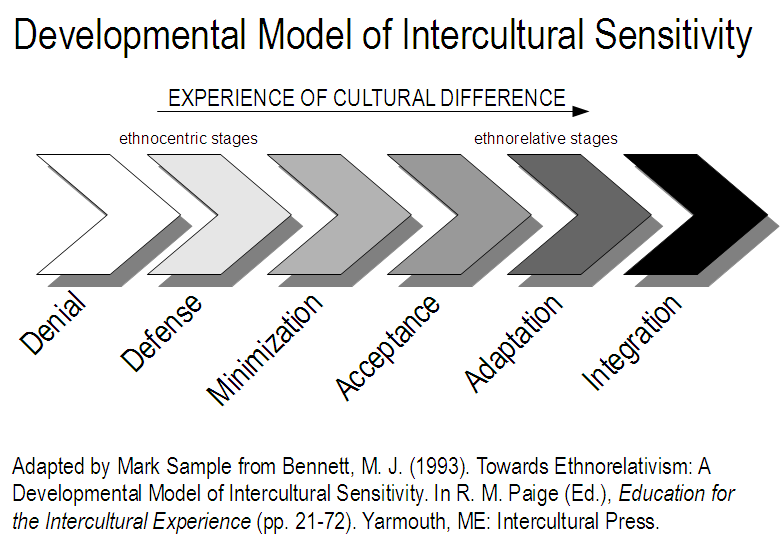
In other words, I believe it is possible to be an ethnorelative person of religious faith; i.e., to be culturally sensitive, to be working through, working out of, the ethnocentric stages of Denial, Defense, and Minimization, and to be growing in relating to other cultures through the experiences represented by Bennett as Acceptance, Adaptation, and Integration. It is possible to accept, adapt to, and even integrate cultural difference, relating to those who are culturally different in an ethnorelative way, and yet to believe in, to know, to live in relation to, God. I don’t know that Bennett would understand this; I do appreciate his challenging us to think through these questions, even if I conclude that he is not totally right in his views; and I think that his model is critically important for religious people, as we consider the reality of culture and how to relate positively to cultural difference.

I don’t know if this is clear, or if I have made my case in a compelling way. I presume there is always more to think about and to talk about, for (even though I believe I know something of reality as well has having some cultural self-awareness) as the New Testament teaches, “we see through a glass darkly.”


Note to any reader: if you have other thoughts either on Bennett’s quotes or my reflections on them, I would love to hear them.


Thursday, May 19, 2011

Beyond Ethnocentrism (3) – Integrating Cultural Difference

“A new type of person whose orientation and view of the world profoundly transcends his indigenous culture is developing from the complex of social, political, economic, and educational interactions of our time.”
Peter Adler, quoted in Bennett, “Towards Ethnorelativism”

(I wonder why he didn’t also say “religious” interactions? But that’s another subject…)

According to Adler, the “multicultural person” is one whose “essential identity is inclusive of life patterns different from his own and who has psychologically and socially come to grips with a multiplicity of realities” (quoted in Bennett).

Bennett refers to such as person as having developed to the ethnorelative stage of Integration.


At the stage of Integration, a man or woman has come to be culturally marginal, existing on the periphery of two or more cultures. One is no longer straightforwardly at home in his or her original culture, neither has s/he assimilated to a different culture. The “integrated person” is not particularly affiliated with any one culture, but “can function in relationship to cultures while staying outside the constraints of any particular one” (all subsequent quotes, unless noted, are from Bennett).

People at the stage of Integration are living in the realm of what Bennett calls “contextual evaluation” – i.e., behavior is determined to be appropriate or not depending on the context (he asks the questions, “Is it good to take off my clothes?” and “is it good to refer directly to a mistake made by yourself or someone else?” and answers both by, “It depends on the circumstances” or context), and have the ability to choose from a range of different cultural responses, to given situations.

“These people see their identities as including many cultural options, any of which can be exercised in any context, by choice. They are not so much bound by what is right for a given culture (although they are aware of that) as they are committed to using good judgment in choosing the best treatment of a particular situation. … They are conscious of themselves as choosers of alternatives…”

Bennett points out that marginality “describes exactly the subjective experience of people who are struggling with the total integration of ethnorelativism.”

“They are outside all cultural frames of reference by virtue of their ability to consciously raise any assumptions to a metalevel (level of self-reference). In other words, there is no natural cultural identity for a marginal person. There are no unquestioned assumptions, no intrinsically absolute right behaviors, nor any necessary reference group.”

For a personal example of what Bennett means, I enjoyed listening to the interactions of my daughter (a TCK who grew up in Tunisia, Egypt and Lebanon, and has also spent significant time in Jordan, besides attending University in the U.S.) with my brothers, all of them pastors or theologians. I would hear one of them make a statement about something (anything), including a phrase like, “the Bible says…” I would listen for my daughter’s response, and inevitably I would hear something like, “that’s one way of reading the Bible; but there are Christians who interpret that statement differently…” That, in a nutshell, is the perspective of a person who is living in the ethnorelative, marginal realm of Integration – they are always able to see things from different perspectives, and from outside of any one framework or cultural setting.

There are two possible phases of marginality, within Integration. At first, one might experience what he calls “encapsulated marginality,” “where the separation from culture is experienced as alienation,” and “constructive marginality,” “in which movements in and out of cultures are a necessary and positive part of one’s identity.” I have seen these two kinds of marginality with TCKs (third culture kids, i.e., people who grow up in a cultural setting that is different than their passport culture). For TCKs at the point of encapsulated marginality, the question, “where are you from?” may trigger an identity crisis – “I don’t know where I’m from; I don’t know who I am; I don’t know where I belong…” But for those who have developed to the point of constructive marginality, they may have come to have a positive sense of identity as a TCK – “I can go anywhere; I can adapt; I can fit in – I’m a TCK!”

Can we integrate difference?
Bennett concludes that “constructive marginality can be the most powerful position from which to exercise intercultural sensitivity,” and points out that “Cultural mediation could be accomplished best by someone who was not enmeshed in any reference group, yet who could construct each appropriate worldview as needed.”

Given the ever-“shrinking” world, with peoples traveling and migrating from and to just about everywhere, there is a desperate need for people who have learned not only to adapt to cultural difference, but to internalize different cultural frames of reference and to live on the cultural margins. Such people can function as “bridge” people between different groups who are different, not just for mediating conflict (for which there is ample need), but also for mediating understanding and interaction.


For more detail, see
Bennett, Milton J., “Towards Ethnorelativism: A Developmental Model of Intercultural Sensitivity.” In Paige, R.M. (Ed). (1993) Education for the Intercultural Experience (2nd ed., p. 21-71). Yarmouth, ME: Intercultural Press.

Bennett, Milton J., “Becoming Interculturally Competent.”  In Wurzel, Jaime S., ed., Toward multiculturalism: A reader in multicultural education (2nd ed., pp. 62-77). Newton, MA: Intercultural Resource Corporation, 2004.


Tuesday, May 17, 2011

Culture Quote of the Day - helping other cultures be like us?

“Cultural, political, economic, and religious ‘missionaries’ are particularly inclined to accept cultural evolution.  Even if adept at intercultural communication, they may nevertheless use those skills to further their own ethnocentrism by helping other cultures to be like them. The point here is not that there is anything wrong with cultural, social, and economic change but that the assumptions about how these changes should take shape are too easily derived from the values of foreigners.”
Stewart and Bennett, American Cultural Patterns

What Stewart and Bennett are getting at here is the phenomenon of people going abroad with their cultural, political, economic, religious, and other plans and programs, but in a way that is insensitive to the different cultural settings they are entering. Having found what "works" for us, we may easily assume universality, and be blind to the ways in which what "works" for us is bound up with our own cultural patterns. When we are operating from an ethnocentric perspective, we inevitably work to help others to be like us - because that's the way that what "works" for us will "work" for them. 

Note that Stewart and Bennett are not opposing change (they mention cultural, social, and economic change, but don't specify 'political' or 'religious,' which they do mention earlier in the quote - is there a significance to this?), but the way in which we attempt to bring it about.

What, then, would be a less ethnocentric way to go abroad, to be involved in change? By the DMIS model, moving into the stages of Acceptance, Adaptation and finally, Integration, we would hopefully encounter people of others cultures
  • realizing that our ways are probably not as universal as we think they are, and not in the way we think they are,
  • being aware that there will be significant cultural difference in another setting, regardless of what we might find to be the human similarities,
  • pursuing knowledge of the cultural differences, i.e., seeking to understand,
  • respecting cultural difference as we encounter it,
  • adapting to the other setting, learning to see the world as they see it, and changing our behavior appropriately
  • believing and acting on the belief that our purpose is not to change others to be like us, not to give them our “cultural baggage,” but to interact and exchange (a two-way street, in which we are likely to gain as much as we give), to offer what we have discovered (in whatever realm), and to allow those we are visiting to do what they like, in their context, with whatever they decide to receive from us.
For those who are confident in what they “have” (as Americans from the U.S. tend to be, but also many others in the world), it is hard to make this adjustment, to accept that our programs and insights and plans, etc., are not as universal as we think they are; to humbly enter another cultural setting as learners, listening, observing, and adapting as we go; and to allow others to accept what we bring – or not – and in accepting, to adapt whatever it is to their setting.

This is difficult, but if we want to have positive, effective intercultural relationships, and to benefit from going abroad, we need to grow out of our ethnocentric ways. And that’s one of the reasons that I spend so much time reflecting on Bennett’s DMIS.

Sunday, May 1, 2011

Beyond Ethnocentrism – Growing in Love of Neighbor Through Growth in Intercultural Sensitivity (1): Acceptance


“One of the ways people inevitably increase their awareness when learning about other cultures is to move from thinking ‘My way is the only way’ toward thinking ‘There are many valid ways’ of interpreting and participating in life.”
Brooks Peterson, Cultural Intelligence

In Bennett’s DMIS (Developmental Model of Intercultural Sensitivity), growth toward a richer, fuller, more positive experience of cultural difference, i.e., growth in intercultural sensitivity, is marked by a transition from ethnocentrism (with stages of Denial – Defense – Minimization) to what he calls ethnorelativism (with stages of Acceptance – Adaptation – Integration).


This growth is characterized by a shift from the experience of one’s own beliefs and behaviors (culture, worldview) as “just the way things are,” to the experience of one’s own beliefs and behaviors as one organization of reality among many viable possibilities (i.e., one’s own culture is experienced in the context of other cultures) – as in the Brooks Peterson quote above. From being unknown, alien, absurd, threatening, insignificant, etc., the cultural difference of others becomes (or begins to become) known, real, comprehensible, respected, etc. This change involves a worldview shift – the world is seen and experienced differently, by a person who is becoming interculturally sensitive.

How do we respond to the "different other"?
The movement from ethnocentrism to ethnorelativism is characterized by the development of cultural self-awareness, accompanied by a growing awareness of different others (i.e., of what makes others different, how they are different). (Note that in a different context, Stephen Covey points out that self-awareness is the key human gift, unlocking all other unique human potential, and that without self-awareness we cannot know others, because we treat them as if they were the same as us.)

Part of the growing awareness of others, and of cultural difference, involves beginning to see both the behavior and the values of people from other cultures, within a cultural context (i.e., as understandable within their cultural context).

“people begin to see alien behavior as indicative of profound cultural differences, not just as permutations of universal (and probably ethnocentric) laws”

“Alternative beliefs about both what exists in reality and the value which may be attached to those phenomena are respected as viable, at least as they are expressed in a cultural context.”
Milton Bennett, Towards Ethnorelativism (emphasis mine)

Movement out of ethnocentrism also involves questioning the universality of our experience, our models, our ways of doing things (be it in education, economics, politics, development, leadership, the way we do church life, or whatever realm). One way in which I experienced movement from the “minimization” stage of ethnocentrism, into a more ethnorelative approach, was in realizing that the apparent fact that Egyptians I knew did not seem to live according to Covey’s 7 Habits might not mean that Egyptians are not effective, but that the “7 Habits of Highly Effective Egyptians” are different than Covey’s 7 Habits (i.e., that Covey’s 7 Habits might not be universal). This seems obvious in hindsight, but the idea that a model which works for us is universally applicable, has a powerful force which is hard to escape.  Once we become more aware of the reality of cultural difference, anyone’s claim to have a “universal” model, approach, or solution, should cause us to see red flags and hear alarm bells.

Moving into Ethnorelativism: Acceptance

The first stage in the ethnorelative experience of cultural difference, in Bennett’s model, is Acceptance. Acceptance is characterized by curiosity about cultural difference, and a growing respect for difference. As one moves into Acceptance, s/he does not necessarily have a deep understanding of the difference which exists, but there is at least a realization that there is difference to be discovered, accompanied by a positive attitude toward exploring and discovering the difference.


Acceptance (in my words) involves…
  • letting go of the idea that reality is simply the way we “know” it to be
  • relating to people as they are, rather than as we would like them to be (or according to our image of them)
  • wanting to know people (i.e., in the reality and fullness of who they are)
  • not trying to change others, to be different or to be like us (which is the tendency of an ethnocentric experience of others)
  • accepting others as being as fully human (and as fully complex) as we ourselves are
  • being open to difference, and open to change (for we cannot grow in accepting others, without ourselves changing)
  • being open to the fact that “what works for us” might not work for others, i.e., that “what works for us” might not be “universal”

To continue my theme of evaluating Bennett’s paradigm from the perspective of Jesus’ command to love our neighbors as ourselves, I ask, does a movement to the ethnorelative stage of Acceptance represent a
growth towards love of neighbor? In other words, if we are people who take the command to love our neighbor as ourselves seriously, should we be motivated to grow out of ethnocentrism, into Acceptance and beyond? Will we be better able to love our neighbor, if we accept the fact that they are different than we are, respect that difference, and try to understand it?

I’ll let you answer that one yourself…


Coming soon… Beyond Ethnocentrism (2): Adaptation


*For full treatment of Bennett’s model, see
Bennett, Milton J., “Towards Ethnorelativism: A Developmental Model of Intercultural Sensitivity.” In Paige, R.M. (Ed). (1993) Education for the Intercultural Experience (2nd ed., p. 21-71). Yarmouth, ME: Intercultural Press.

Bennett, Milton J., “Becoming Interculturally Competent.”  In Wurzel, Jaime S., ed., Toward multiculturalism: A reader in multicultural education (2nd ed., pp. 62-77). Newton, MA: Intercultural Resource Corporation, 2004.

Saturday, April 30, 2011

Culture Quote of the Day - the danger of assuming relevance

“There are probably levels of ethnocentrism, moving from the narrow collectivism of my family, my village, to my clan, my state, my country or my race. There may be dozens of ever-expanding circles as the ripples in the pond expand outward.”

“...the ethnocentric leader has limitations. As pastors and missionaries reach out to the rest of the world, they will do so from the perspective of the leadership values of their own culture and assume that what they have learned about successful churches will apply to all cultures. This attitude can cause tensions with global church-to-church partnerships. Because of their limited perspectives, crosscultural workers assume that their cultural values are biblical and universal. The ethnocentric pastor of a megachurch in one culture will assume that the principles of success in his or her church are effective in any culture.”
James E. Plueddemann, Leading Across Cultures

In Bennett's terms, what Plueddemann is identifying as the problem of ethnocentric religious leadership is located in the last of three ethnocentric phases in the DMIS model, minimization (see http://contextualliving.blogspot.com/2011/03/how-ethnocentrism-hinders-love-of.html). This seems to be a significant problem for people of faith, because in attempting to be true to God and the Scriptures, we can easily wrap up what is assumed to be "absolute" and "eternal" (i.e., from God) with our cultural ways and perspectives.

The question is, can we escape our ethnocentrism, move on to a different way of understanding and interacting with cultural difference, that will enable us to relate more positively, more effectively, with peoples of other cultures? 

Thursday, April 28, 2011

Culture Quote of the Day - Similar or Different?

“I don’t find it useful to minimize cultural differences. Nor do I find it useful to exaggerate them. The world may be drifting toward similarity in some ways, but it is certainly maintaining distinctness in other ways. I don’t find it realistic to talk about a ‘world culture,’ and I am horrified at the idea of cultural homogenization because I’m fascinated by cultural differences. So I recommend that internationally focused professionals expect, prepare for, and embrace cultural difference. Then it’s possible to be pleasantly surprised when encountering cultural similarities. This is far better than expecting only similarities and being shocked by unanticipated differences.”
Brooks Peterson, Cultural Intelligence

“It is dangerous, though, to overemphasize cultural differences. In the deepest sense, human beings are more alike than different. Physically we have similar DNA, blood type, bone structure, facial features and thousands of other characteristics. Socially we have similar needs for belonging, acceptance, security and fulfillment. Cognitively our differences are variations on a limited number of themes. Spiritually we are formed in the image of God, with the special breath of God. We have the ability to know and love God. The paradox is that all human beings are mostly alike, yet each is distinct.”
James E. Plueddemann, Leading Across Cultures 

Are people more alike, or more different? How do these two authors view the relationship between similarity and difference? Do they agree with each other?

Cultural difference exists. Everyone who is beyond Bennett's stage of "Denial" recognizes that (on "Denial" of cultural difference, see http://contextualliving.blogspot.com/2011/02/loving-our-neighbor-insights-from.html). But similarity also exists. The question is, are people more similar or more different? And how does one balance seeing similarity with recognizing difference? 

In Bennett's framework for looking at how we experience cultural difference, the third and last stage of Ethnocentrism, "Minimization," is one in which people assume that similarity between people is greater than the difference. This stage is ethnocentric, though, and problematic (if not dangerous) for intercultural relations, because in minimizing difference we project our own culture onto others, assuming they are basically like us, and that what works for us will work for everyone else as well (see http://contextualliving.blogspot.com/2011/03/how-ethnocentrism-hinders-love-of.html).

The question is, what is it to move beyond an ethnocentric experience and view of difference (and similarity), to a deeper, richer, more positive (what Bennett calls ethnorelative) experience of difference? And how does the movement into a deeper appreciation of difference, affect our view of similarity between peoples, what people have in common?

Thursday, March 24, 2011

What’s Wrong with Ethnocentrism?

To return once more to the topic of ethnocentrism (i.e., seeing and experiencing and interacting with the world from the perspective of your own culture / your own frame of reference, without an understanding of the different cultures of others, or the ability to enter into their frame of reference and experience), I would like to ask whether ethnocentrism is compatible with faith, and if not, what’s wrong with it?

Here are some of the characteristics of ethnocentrism, with reference to the stages of Bennett’s “Developmental Model of Intercultural Sensitivity”*:

(Denial)
  • lack of awareness of cultural difference
  • lack of interest in cultural difference
  • inability to distinguish cultural difference (e.g., thinking of “Africans” or “Asians” or even “foreigners” as a broad category without internal differentiation)
  • isolation or intentional separation from different others
(Defense)
  • lack of understanding of cultural difference or others who are different
  • a negative experience of difference, and reaction against it – feeling threatened by difference
  • one’s own culture experienced as the only viable one
  • polarization (“us” / “them”)
  • generalizing and positively stereotyping one’s own people and culture
  • generalizing and negatively stereotyping other peoples and cultures
  • prejudice, denigration, possibly animosity, toward those who are different
  • in the extreme, dehumanizing and/or demonizing others
(Minimization)
  • trivializing difference, acting as if people are basically the same (i.e., as if others are basically the same as ourselves)
  • thus, not relating to others as they truly are, in their uniqueness or fullness
  • lack of cultural self-awareness
  • generalizing from one’s own experience, principles, practices, to others – assuming that what “works for us” is universal, relevant and applicable anywhere and everywhere and to everyone
  • those in a dominant or majority group not being aware of how racial minorities experience race relations, men not being aware of how women experience gender issues, etc.
  • assuming we have “the answers” for everyone, not being aware that the questions that others are asking, may be different than our questions
In sum, ethnocentrism is a form of self-centeredness, on a group and cultural level. It ranges from ignorance through defensiveness to a somewhat benign assumption of similarity, but in all cases, one cannot know and relate to others as they are, from any point on the spectrum of ethnocentrism.

There are many reasons why someone might decide that it would be best not to stay in an ethnocentric state.

From a faith perspective, I would argue that ethnocentrism, while “natural” to people, is not compatible with living according to the example and teachings of Jesus.

Take Jesus’ central teachings, to “love our neighbor as ourselves,” and to “do unto others as you would have them do unto you.” As a starting point, it would seem that these commands would necessitate having an interest in knowing others and relating to them. And both “loving” and “doing unto others” would seem to clearly imply not looking down on them, negatively stereotyping, being biased against, or despising them. Thus, it seems obvious from the beginning that the “denial” and “defense” stages of ethnocentrism do not square with Jesus’ teaching.

To go deeper, in the broader context of the teachings of the New Testament one might define love as encompassing many other relational teachings, e.g., the exhortations to accept one another and to honor one another. To take just those two, it would seem obvious that a depth of accepting and honoring another person requires knowing that person as they are. The more fully I know someone, the more deeply I will be able to (learn to) accept or honor them. And this would be true of the “do unto others” command, which is really a way of summarizing what it means to love someone – what I want of others is that they understand me as I am, and accept and otherwise relate to me as I am, not according to an inadequate or distorted image of me.

It doesn’t take much empathy to imagine that for a person of color, having a white person treat you as if you are the same as them, without any understanding of your personal or group experience of discrimination, etc., is not loving (or even tolerable); or for a woman, to have men blithely proclaim that “we have no problem with gender issues here,” without ever listening to your experience or perspective on the matter, falls short of a positive or even acceptable relationship (to say the least). And anyone who has been on the receiving end of some other person or group coming in with the (“universal”) answers to what they perceive to be your need or problem, knows how obnoxious that approach is. Therefore, “minimization” also falls short of relating well to other people, and thus, to living according to the teachings and example of Jesus.

Ethnocentrism, in one way or another, in one form or another, is at the heart of many of the problems which exist between groups of people in the world today (and throughout history). It seems clear to me, as a follower of Jesus, that living up to the ideals and standards of our faith should lead us to reject, and seek to identify and grow beyond, ethnocentrism in all of its manifestations.

Coming soon: Beyond Ethnocentrism…


* For more details on each of these stages, see:

For full treatment of Bennett’s model, see
Bennett, Milton J., “Towards Ethnorelativism: A Developmental Model of Intercultural Sensitivity.” In Paige, R.M. (Ed). (1993) Education for the Intercultural Experience (2nd ed., p. 21-71). Yarmouth, ME: Intercultural Press.

Bennett, Milton J., “Becoming Interculturally Competent.”  In Wurzel, Jaime S., ed., Toward multiculturalism: A reader in multicultural education (2nd ed., pp. 62-77). Newton, MA: Intercultural Resource Corporation, 2004.

Tuesday, February 15, 2011

Culture Quote of the Day

“We don’t see things as they are, we see them as we are.”

I have seen this attributed to Anais Nin. I have heard it quoted in the film Anna and the King, which to me is a beautiful film illustrating the process of someone growing from being ethnocentric (seeing and evaluating the world from their own cultural perspective, and discounting other perspectives) to being what Bennett (in his “Developmental Model of Intercultural Sensitivity”) calls ethnorelative (or what one might call ethnosensitive), realizing that one’s cultural perspective is one among many in the world.