Showing posts with label Christians and Muslims. Show all posts

Wednesday, August 24, 2011

Muslim-Christian Relations, 10 years after 9/11

This article - which quotes several of my friends - highlights the challenge of Christian-Muslim relations in our post-9/11 world.

There are lots of strong and different opinions on all sides of this critical issue. Personally, I see the matter - how we relate to the "different others" - as a test of faith, reflecting on the quality and nature of our faith, and the God we believe in. How are we who claim the name of Jesus doing, in reflecting His example of loving our neighbors and even our enemies?

Tuesday, August 9, 2011

Culture Quote of the Day - different views of God, more likely to fight?


 “...the more different the gods worshipped by various peoples, the more likely, all other things being equal, that their respective worshippers will come into conflict and the less likely that they will find peaceful resolution of conflict”

“The claim that Muslims and Christians worship radically different deities is good for fighting, but not for living together peacefully.”
Miroslav Volf, Allah: A Christian Response


I'm not sure.

Volf's book is excellent, and I agree with most of his arguments and his main points. I'm not sure, though, that I agree that there is a correlation between how different peoples' conceptions of God are, and their likelihood of experiencing conflict.

Some thoughts:
1. I wonder if closeness in concept of God may be even more of an irritant, at least in some cases. Take (at least in certain times and places) different groups of Christians, e.g., Catholic and Protestant. We're talking about the same God, or at least a fairly close conception, and yet, plenty of conflict.

2. It seems to me more significant, whether a group's concept of God is one that tends toward peace and forgiveness and peacemaking or not. E.g., Jesus teaches us to forgive, to make peace, to love our neighbors and even our enemies. Regardless of whether Muslims or anyone has a close conception of God to mine, as a follower of Jesus, I should - if I follow the teachings of Jesus - do everything possible to live in peace with those others.

On the second quote, I think that the correlation is that in times of tension (like those between Muslims and Christians, post-9/11), both communities are more likely to emphasize different concepts of God, in a knee-jerk reaction to push away those different others that they are in conflict with. One could also say (reinforcing my point #2) that the view of God of the extreme Muslims, is a violent view, and leads them to their violent actions. But their view is considered by the vast majority of Muslims to be extreme and not representative of the true teachings of Islam.

In any case, I recommend Volf's book as a good and critically important read in these days of Muslim-Christian tensions.

Friday, July 1, 2011

Allah: A Christian Response

I have read many books (and answered many questions) related to the question of whether Christians and Muslims worship the same God. This is the best book I have read on the subject, and it is particularly helpful and interesting because Volf addresses the broader context, including ways in which God and religion serve as identity markers and contribute to conflict between groups. His discussion of the views of some key historical figures (including Martin Luther) on the question is very helpful. And a significant part of the book is the discussion of whether Christians and Muslims can find a way to work together for the "common good" (rather than trying to destroy each other).

I highly recommend this book, for Christians and Muslims alike. But to benefit, you have to approach it with an open mind...

Monday, April 11, 2011

Where Will the Tunisian and Egyptian Revolutions Lead?

I have recently visited both Tunisia and Egypt, two countries I lived in for a number of years. There are of course numerous differences between the two countries, in population (number of people, plus the fact that Egypt has always had a sizeable Christian minority), urbanization, literacy, religious practice, and other areas, but I was struck by an issue that popped up in both places, in the form of graffiti.

In both places, patriotism (in the form of lots of flags and graffiti highlighting the flag) was in prominent display.  In addition, and more specifically, in Tunisia, I saw graffiti that read “Tunisian = Muslim + Christian + Jew": 

Tunisian People = Muslim + Christian + Jew
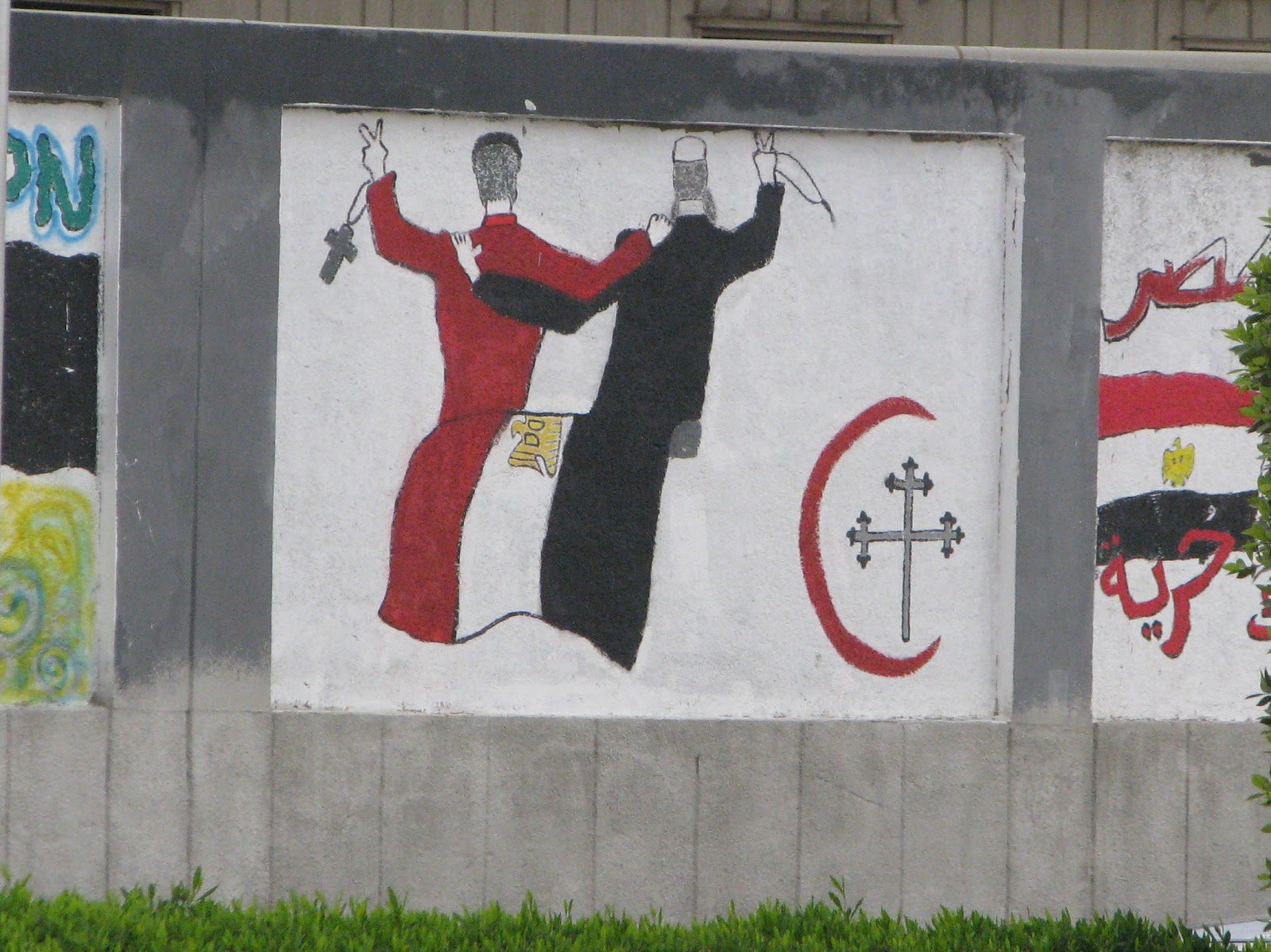
In Egypt, a sign that read, “Don’t say we are Muslims, not Christians – we are all Egyptians” (unfortunately, I didn’t manage to get a picture of this one), and graffiti highlighting a close relationship between Muslims and Christians in Egypt:


The underlying issue that this graffiti is addressing is one of whether the emphasis coming out of the revolutions, in creating new governments, will be on religion – i.e., emphasizing the Muslim identity of the majority of the people – or on the nation / national boundaries – i.e., emphasizing common identity as Tunisians or as Egyptians, national unity, and downplaying religious differences.

One Nation .. One People (?)
This is a key issue, especially in Egypt (with a large percentage of Christians). The question for Muslims in both Tunisia and Egypt is, is it possible for them to create or emphasize or demonstrate a religious identity that allows them on the national level to embrace (be inclusive of) others who do not share their religion?

And for the record, this is not just a Muslim issue – it is easy to find examples around the world (including the West, and countries with a “Christian” majority) that illustrate the same tension between religious commitment and national commitment, and the same question, whether those with strong religious commitment are able to create and live out a religious identity that allows them on the national level to embrace others of other faiths (or none).

Given all the strife in the world today that is centered on religion, this is a critical question for all of us, whatever our religious faith and whatever our nationality. I’m hoping that the forces for unity in Tunisia and Egypt are stronger than the forces for exclusion.

Monday, October 4, 2010

The Role of Religion / Religious People in Society?

There is an interesting synopsis of a new book by J.D. Hunter, To Change the World, accompanied by an interview with Hunter, in a recent issue of Christianity Today (see http://www.christianitytoday.com/ct/2010/may/16.33.html?sms_ss=facebook&at_xt=4ca647dc78f83efd,0&start=1), on the subject of the role of Christians in society, and particularly, whether Christians should (and can) try to bring about “culture change.”

One of the things which struck me in reading the interview and thinking about Hunter’s conclusions is that what some Christians and others fear in Muslims these days (e.g., their trying to take over America and impose their will – I have read numerous accounts recently of how Muslims want to eventually impose Sharia law on America), is similar to what many others fear in Christians (with the talk, in some circles, of reclaiming America as a "Christian" nation, etc.). I find Hunter's argument as reflected in this synopsis and interview (I haven't read the book yet) relevant to this whole complex of tensions centered on issues of religion & society.

Hunter's last quote from the interview:
"Christians need to abandon talk about "redeeming the culture," "advancing the kingdom," and "changing the world." Such talk carries too much weight, implying conquest and domination. If there is a possibility for human flourishing in our world, it does not begin when we win the culture wars but when God's word of love becomes flesh in us, reaching every sphere of social life. When faithful presence existed in church history, it manifested itself in the creation of hospitals and the flourishing of art, the best scholarship, the most profound and world-changing kind of service and care—again, not only for the household of faith but for everyone. Faithful presence isn't new; it's just something we need to recover."

For another opinion on the subject, Chuck Colson, who we might characterize as a “Christian activist” for his work in prison reform, responded to the interview with Hunter (http://www.christianitytoday.com/ct/2010/mayweb-only/29-52.0.html?start=1), essentially arguing that it's not "either/or" when thinking about the role of Christians trying to shape and change the society. Colson is emphasizing another aspect of Christian social activism - not an attempt to reclaim America as a "Christian nation," but an active involvement in working against injustice in various domains, whether slavery (Wilberforce is his hero for Christian political engagement), racism or prison reform (one of Colson's main areas of activism).

A couple of Colson's comments:
"That brings me to my biggest concern about Hunter's argument: The "faithful presence" he advocates most likely will result in Christians remaining silent in the face of injustice and suffering. Instead of seeking the welfare of the city in which God has placed us, we are indifferent to its decay and that decay's impact on the life of our neighbors."

"In his Christianity Today interview, Hunter said, "When Christians turn to law, public policy, and politics as the last resort, they have essentially given up on a desire to persuade their opponents. They want the patronage of the state and its coercive power to rule the day." I doubt he would have said that to Dr. Martin Luther King or to William Wilberforce when they waged long and heroic battles against injustice."

As I thought of a title for this posting, I was uncertain – what are we talking about? Is this an issue of the role of “religion” in society? But “religion” is a concept, a complex of ideas (and prescribed practices and beliefs), but as such, inanimate – i.e., a “religion” cannot think or take action; only people can do that. So, are we talking about the role of “religious people” in society? Or would it be better to say it was about the role of “people of faith” in society? Does it make a difference?

I’m wondering whether it might make a difference. Is the point, taking action that is rooted in religion, i.e., in the teachings of a particular religion, like Christianity (or Islam)? But perhaps that is where others become nervous – Christians are nervous about Muslims acting in the name or the cause of Islam as a religion, secular Americans are nervous about Christians acting in the name or the cause of Christianity as a religion, etc. – because, I think, we are nervous about other people trying to “take over” the society with and for their religion, and impose the beliefs and practices of their religion on the rest of us.

This is a central problem, in a pluralistic society, based on an attempt to find ways for people who are different to coexist, enjoying freedom of belief and practice, protecting everyone from anyone else imposing their beliefs and practices on us, and from our imposing our beliefs and practices on them. Remember that in the beginning, “freedom of religion” in America was almost universally translated into “freedom for us – whoever ‘us’ was in a given place – to practice our religion,” but not for others – whoever was in a majority imposed their faith and practice on everyone else; and we’re talking Christian to Christian here (the exceptions, of course, were Rhode Island and Pennsylvania, both established from the beginning by minority Christian groups who were persecuted by Christians elsewhere, with a commitment to freedom of faith and practice for all, as the foundation of peaceful coexistence).

I think that at least part of what Hunter is getting at, is that Christians should not be acting in the public realm in an attempt to gain the majority or take over, (re) Christianize America, and push through our beliefs or practices on the nation as a whole. What Colson is talking about, I think, is somewhat different – he advocates faith-based activism to work against injustice, exploitation, etc. in society, giving examples of slavery, racism, and various issues in the criminal justice system. He is not trying to change laws to specifically reflect Christian values, but rather, values that would be broadly shared by both religious and even nonreligious people.

Perhaps in the end it is a matter of the language we speak, what we say as we are taking action in society. If we talk in terms that may be readily understood and accepted by people in our own religious circle (however broadly or narrowly defined), we will likely run into resistance from people of other religious convictions. If we can find a broader, more widely accepted value system to appeal to, though, our (for us) faith-based actions might be seen, not as threatening, but as “good news” to others in the society, and we might even find allies in people of other faiths (e.g., Muslims) or none, who do not share our religious convictions, but do share some of our values.

Friday, September 10, 2010

Should people of different faiths talk with each other?

I experienced something of an online firestorm recently when I posted a link to a new initiative called the Global Faith Forum (see http://www.globalfaithforum.org/; see also the blog site, http://www.glocal.net/). Under the question “Why Attend?” the site says,

“The Evangelical Church says we want to reach the world, but do we really understand the world? At the Global Faith Forum, we’re moving from a conversation about other faiths, to a conversation with other faiths. A conversation that allows us to hear from leaders with different faiths, different worldviews and different ideas that shape the way we communicate in the 21st century.”

In posting this link, I commented:


“It seems to me that a question faced by all people of religious faith is, are we prepared to relate to different others? Many religious people have the perspective (of the medieval Catholic church and others) that "error has no rights," and believe in trying to convert others, but not in really relating to and understanding them. In the spirit of Jesus, who "became flesh and dwelt among us," I like this "Global Faith Forum," emphasizing conversing with (and relating to) people of other faiths. And surely, if you are a person of faith, you must see that the strongest way to influence others is to start by actually relating to and engaging them (rather than, for example, burning their sacred books).”


In response, one of my friends commented:

“What a complete error in logic!... "became flesh and dwelt among us," Jesus became a "human" ...In that sense ONLY is there a universal connection. He did not become "flesh and dwell among us” --Jews or Arabs or 'Samaritans' to dialogue about the good points of their religious belief system--the fact that they were "different others" other than to tell them they were lost and wrong! " Christianity is 100% exclusive! Who is this Jesus that you see and preach?? Who is this warm and fuzzy Jesus that you make out to be so inclusive??
I can just see Jesus saying... "I want to hear from leaders of different faiths so that we can talk." Read John 8...let's start there.

And

“The anemic buzz words of post modern academia..."different others", "co-religionists"...
In the latter part of John 8 Jesus is not in a discussion or dialogue regarding the value or sanctity of someone's religious view. "43 Why do you not understand what I say? It is because you cannot bear to hear my word. 44 You are of your father the devil, and your will is to do your father’s desires. He was a murderer from the beginning, and has nothing to do with the truth, because there is no truth in him. When he lies, he speaks out of his own character, for he is a liar and the father of lies." et al...

There is no appeal for "mutual understanding" here--neither is he calling them to repent.

To believe Jesus would sit in on and entertain a "Global Faith Forum" is ludicrous at the least and blasphemous at the outset. Get this mental picture --Jesus sitting at the round table with all those panel members, "speakers" from different faiths --the ONE among many. What a hoot! I wish I were a cartoonist because THAT would be a great cartoon!

"For you, O LORD, are most high over all the earth;you are exalted far above all gods."

At the end point of your fallacious view what would you do once you entered into dialogue and gained "understanding"--THEN tell them you need to believe in Christ and repent?? So your real agenda would be what??”

The question raised for me is, should (can?) people of faith talk with people of other faiths? It is interesting that there are people in every religious community, it seems, who are against “dialogue.” I have heard some say that unless they (the others) are interested in understanding what we believe, etc., “we have nothing to talk about.” In general, it seems, there is an interest in talking to – in the sense of stating one’s beliefs, distinctives, etc. – more than in listening to, those of a different faith.

It seems to me, as a Christian, that apart from the issue of the value of so-called interfaith dialogue, surely Jesus would direct his followers to enter into relationship with others? Many Christians, it seems, tend to sit back and “throw stones,” and live in fear of who we do not know. If we don't enter into relationship with other people, we are simply talking or preaching at them, which does no good (especially in these days of heightened tensions between Christians and Muslims, West and East).

Jesus said that his followers should be "salt" and "light" in the world. (One of the points of Jesus' coming to earth and "dwelling among us," I think, is that God was not content to just give us a book or speak from afar - Jesus' life represents God entering into peoples' lives and relating to us. His disciples wrote of "what we have seen and heard and our hands have touched.") And I think, given that he himself is and is about "good news," that it is at least implied that Jesus' followers should be "good news" to others.

Unfortunately, it seems that the way we Christians relate to Muslims and others is often perceived as bad rather than good news. The New Testament also says that Jesus' followers are his ambassadors, and again, it seems to me that this requires entering into relationship with people. So if a Christian is wanting to share his/her faith with Muslims, the best thing to do is to enter into relationship with them (and love them, which is Jesus' first and foremost command to us re. how we relate to others).

And beyond that, if we are concerned more broadly for our society, it seems that bringing different people together to get to know each other is a key foundational step away from war and toward peaceful coexistence (which is a baseline issue for even having a society). And I do believe that most Muslims in America, as most others in America, actually want to peacefully coexist.

But I headed this post, “Should people of different faiths talk with each other?” not “Should Christians talk with people of other faiths?” I have been talking here as a Christian to other Christians, because that is my life and my people. But I would bring this around to Muslims or those of any other faith – what about you? Do you believe in relationship with (and talking with and listening to) people of other faiths? Do you have a firm belief in the common humanity of those of other faiths? If you believe in spreading your faith, do you believe in doing so through relationship? Do you believe that we should be working together not to build more barriers between us, but to break them down, even to look for common understanding and common ground?

Can we – all of us who are people of faith – have the courage and the strength of our own convictions, to listen to (rather than just talking at) each other, to enter into relationship and get to know each other? I believe that this is good for our faith and for our world.