Showing posts with label Tunisia. Show all posts

Friday, June 24, 2011

Cross-Cultural Friendship Revisited

I think my previous post, "Is It Possible to Be Friends With Someone of Another Culture or Religion?" may have come across that it was hopeless. I didn't mean to leave it that way, just to raise the question, to reflect on the fact that building friendship with someone from a different culture or religion can be tricky, can present surprises and challenges along the way, because of our different expectations about friendship and ways of approaching friendship.

I know, for example, that I have disappointed Arab friends at different times. Americans tend to be quickly "friendly," with people we barely know; but as individualists (culturally), and due to various factors, we have boundaries around the expectations between friends. Even a good friend, for example, might call and need help, but will accept various excuses if it doesn't work out; an Arab, though, in general, would never not help a friend, even if it were very inconvenient.

That's the thing. Friendship, I think, is about how deeply you can share with another person. It's about trust. And it's about what you can depend on, what you can expect. It's about loyalty, who will stick by you, and through what? At the very least, a cross-cultural or cross-religious friendship takes time, perhaps (?) longer than one with someone culturally and religiously closer. (And for me, there are levels or degrees of relationship, of friendship, or perhaps circles.)

So to conclude, I made some new friends this past week at the "Building Hope" Conference - some new Christian friends (American and other), some new Jewish friends (mostly Orthodox, and from different countries), and some new Muslim friends (from America and from both Muslim-majority and Muslim-minority lands). But I use the term carefully - we were "friendly" with each other, and we began sharing stories (some of them deep, profound, very personal); we began (at least some of us with some others) talking about our "personal" lives, our families. We began...we laid a foundation. But it will take time for the relationships to go deep, to get to know each other well, build trust. And we'll probably have to pass through periods/areas of Miroslav's "non-understanding."

And to return to Tunisia, I do have strong Tunisian friendships. I lived there for 12 years, and spent thousands of hours with many different people. I know several Tunisian friends who I absolutely can count on - if I showed up in Tunisia, homeless (or not), and in need (of any kind), they would take me in (no questions asked), give me money or whatever I needed, and make sure I was all right. They would treat me (in my book) as if I were family. And that's partly the beauty of the Tunisian (Arab, Muslim) cultural way of treating people you have spent much time with. 

Monday, May 9, 2011

Are science and medicine culturally relative?

I would like to consider two non-religious examples, medicine and science, to see whether it is possible to be ethnorelative (Bennett's term) but believe that something is true.

In Tunisia, there was what they called "Arab medicine," which is how they referred to traditional Tunisian medical concepts, meds, etc., and what they called "French medicine," by which they meant Western or modern medicine.

To be ethnocentric toward Tunisian "Arab medicine" might be to discount it (as stupid, false, irrelevant, superstitious, backward, etc.) without understanding it, not to see it in its broader cultural context, etc. - i.e., to judge it from an outside frame of reference (that which I as an American know to be "true" in regard to medicine).

To be ethnorelative would involve understanding Tunisian "Arab medicine" within its cultural context, which could include understanding something of the history (how and why certain concepts or practices arose), cultural connections (including religious and other belief systems), contexts in which someone would use "Arab medicine," and how they would use it, etc.

"French medicine" came into Tunisia from outside (as has been common with the spread of modern technology, scientific and medical knowledge, etc., in modern times - don't forget, though, that at one point the Muslim world represented the high point of medical, scientific and other knowledge in the world). It has fit in, and functions within the system, alongside the traditional "Arab medicine" (within the society, the culture).

You can "prove" the "truth" of much of modern medicine, e.g., that bacteria and viruses exists, the effects of antibiotics (or the lack of using them) and other meds on various conditions, etc. (note, however, that modern doctors don't know everything, can't always figure out either what is wrong or what to do about it, and meds don't always "work" - there's an awful lot of guesswork and experimenting to see what effect a certain treatment has).

Is it ethnocentric for someone who is non-Tunisian to believe in the truth of modern medicine, and to bring it into Tunisia ("we bring you true medical knowledge and medicine")? I would have to say, that depends on the person's attitude and their interaction with Tunisian society and culture. It would certainly be possible to enter Tunisia as an outsider, with your modern medical knowledge and meds, in a way that trampled on the local people, treated them as ignorant, ignored their culture, etc., and acting as if everything modern or western was superior, etc. (I have heard Tunisians complain of the way certain Westerners have lived in Tunisia, in how they viewed and treated Tunisian culture). If your goal was to have a positive impact on Tunisia, through bringing modern medicine, you might well fail, if you came in an ethnocentric way.

On the other hand, it would be possible, I would think, to believe in the "truth" of modern medicine, and to introduce it to Tunisia in a non-ethnocentric way - if you cared about the local culture (and sociocultural context), sought to understand local medical beliefs and practices (as well as the broader culture), learned to adapt to the culture and relate well to the people (to see the world from their perspective), etc. You might offer modern medicine not in a "we are the civilized people and you are the ignorant barbarians" way, but in a "we have something that we have discovered, that might be of use to you, and we'd be glad to share it with you if you're interested" way, and (as mentioned) with an understanding of how things actually work culturally in Tunisia. (Note that the history of aid and development is littered with projects which failed because of lack of cultural understanding.)

Being ethnorelative rather than ethnocentric in introducing something like medical practices that you believe to be true, to another culture, means seeking to share the knowledge, practices, etc., without your own cultural "baggage," allowing those you give the info and practices to, to adapt them to their own cultural context in their own way.

I think the same would apply with scientific knowledge or truth, in various areas of science.

The other thing I'll say, at this point, is that in medicine and science, as in the "softer" areas of life, human beings "see through a glass darkly" - e.g., throughout history we have been certain of scientific and medical "truth," only to have our knowledge challenged, undermined, and changed at a later point in history. This has been true in all areas of knowledge, all areas of "truth." And this is one of the reasons that when it comes to relating to people who have other knowledge and experience, we should not be too quick to judge either the inferiority of their "truth" or the superiority of ours (or who are the "civilized" and who are the "barbarians").

Monday, April 11, 2011

Where Will the Tunisian and Egyptian Revolutions Lead?

I have recently visited both Tunisia and Egypt, two countries I lived in for a number of years. There are of course numerous differences between the two countries, in population (number of people, plus the fact that Egypt has always had a sizeable Christian minority), urbanization, literacy, religious practice, and other areas, but I was struck by an issue that popped up in both places, in the form of graffiti.

In both places, patriotism (in the form of lots of flags and graffiti highlighting the flag) was in prominent display.  In addition, and more specifically, in Tunisia, I saw graffiti that read “Tunisian = Muslim + Christian + Jew": 

Tunisian People = Muslim + Christian + Jew
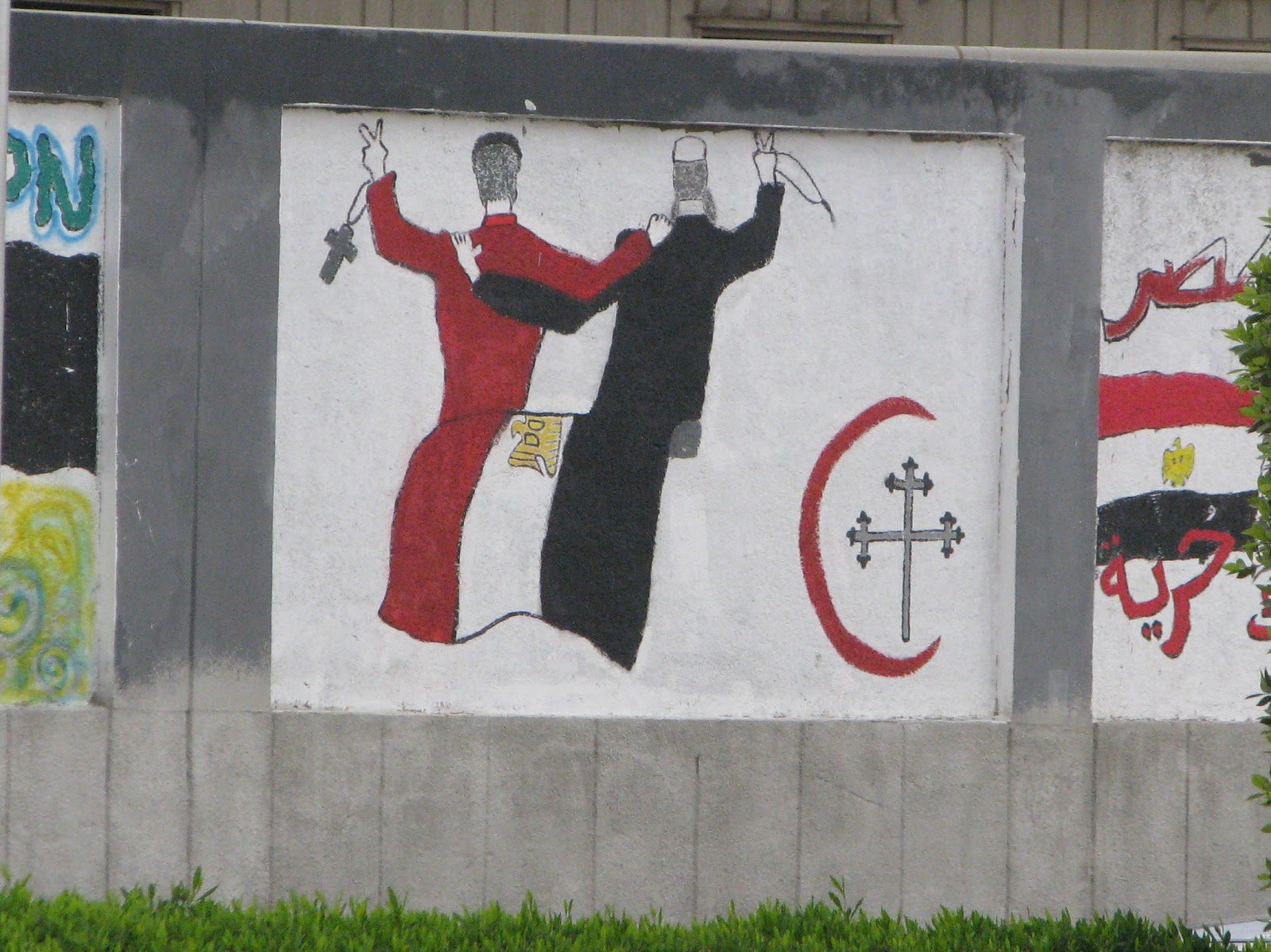
In Egypt, a sign that read, “Don’t say we are Muslims, not Christians – we are all Egyptians” (unfortunately, I didn’t manage to get a picture of this one), and graffiti highlighting a close relationship between Muslims and Christians in Egypt:


The underlying issue that this graffiti is addressing is one of whether the emphasis coming out of the revolutions, in creating new governments, will be on religion – i.e., emphasizing the Muslim identity of the majority of the people – or on the nation / national boundaries – i.e., emphasizing common identity as Tunisians or as Egyptians, national unity, and downplaying religious differences.

One Nation .. One People (?)
This is a key issue, especially in Egypt (with a large percentage of Christians). The question for Muslims in both Tunisia and Egypt is, is it possible for them to create or emphasize or demonstrate a religious identity that allows them on the national level to embrace (be inclusive of) others who do not share their religion?

And for the record, this is not just a Muslim issue – it is easy to find examples around the world (including the West, and countries with a “Christian” majority) that illustrate the same tension between religious commitment and national commitment, and the same question, whether those with strong religious commitment are able to create and live out a religious identity that allows them on the national level to embrace others of other faiths (or none).

Given all the strife in the world today that is centered on religion, this is a critical question for all of us, whatever our religious faith and whatever our nationality. I’m hoping that the forces for unity in Tunisia and Egypt are stronger than the forces for exclusion.

Wednesday, March 23, 2011

Do we support freedom of religion and nonestablishment of religion out of convenience, or on principle?

In response to my post about whether Tunisians will embrace a secular constitution or not, a friend wrote and asked whether I thought that the process of Christians embracing freedom of religion and separation of “church” and “state” was just motivated by convenience (things would “work better”), or whether such a commitment is actually rooted in Christian teaching?

My conviction is that the teachings of the Bible and the example of Jesus inherently support freedom of religion and nonestablishment (especially, not using establishment of religion to persecute others who differ in belief or practice, whether other Christians, or people of other religions or none).

I would point to the fact that the Bible teaches that God has given men and women the responsibility and the freedom to respond to him (or not), and that we are not to judge others, but to leave judgment to God; and that Jesus taught that his “kingdom” was not a political kingdom (e.g., a political alternative to Roman rule), but was of a different nature, meant to work (as leaven, in one of his parables) within existing social structures (of any kind).

It is my understanding from reading Christian history, that there has been a progression both in thinking about how to best live together in society with others of different faith (Christian and other), from a practical standpoint, and in (re)thinking about Biblical perspectives  on the relationship of “church” and “state,” on a level of foundational principles. I don’t know of anyone advocating that Biblical teaching would encourage Christians to seek to return to an establishment of religion or an abolishing of freedom of religion (though there are those calling for a return to America as a “Christian nation,” and there is what I see as a natural tendency for any group of people to want to have their own beliefs and practices and social standing, protected from or by the government – i.e., a group self-centeredness, which might lead Christians to act as if they did not think that the Bible’s teaching would lead us to stand up for freedom of religion for all people, not just for ourselves).

Jesus taught that we should “love our neighbor as ourselves,” and that we should “do unto others as we would have them do unto us.” Both of these teachings, I would argue, should lead us as followers of Jesus (or “Christians,” if you will) to stand for freedom of religion for all, and for nonestablishment of religion for all, for the sake of us all.

My question, then, to followers of other religious teachings would be: am I right in thinking that your faith would lead you to stand for the same freedom for all, and disestablishment of the religion of one particular group, for the sake of equal rights for all?

Monday, March 7, 2011

Should Tunisia adapt a “secular” constitution? (thoughts in the wake of the "Jasmine Revolution")

Let me start with my conclusion: it's up to the Tunisian people. I have no interest in telling the Tunisian people what they should do (that would seem a bit contrary to the principles of self-determination, democracy, etc.). I find this issue a very interesting one, however, and share these thoughts out of my personal interest, and as someone who lived in Tunisia in the past, who loves Tunisia, and who taught American history and religion in America here to Tunisian students.

Tunisia's constitution, which has been in effect since independence in 1956, has said that Tunisia is a state whose language is Arabic and whose religion is Islam. I say “has said,” because the constitution has just been suspended after the Jasmine Revolution. There will be elections for a council that will write a new constitution.
 
One of the questions which is being debated is whether the new constitution should establish Islam as the state religion, or whether Tunisia should be a “secular” state, with a separation of religion and politics, and equal rights and freedoms given to all people, whatever their faith (Tunisia has a small number of Jewish citizens, a few B'hai, some Christians, and a few others, e.g., those who consider themselves atheists; but the vast majority of the Tunisian people are Muslim of one kind or another).
"The Tunisian people = Muslim + Christian + Jew"
I was in a long and interesting discussion recently with some Tunisian friends about this matter. I wish I could spend more time here, and hear what others are thinking.

Here are some of my thoughts:

On the one hand, I think it will be difficult, perhaps impossible, for a decision to be made to adapt a secular constitution, due to the fact that the vast majority of Tunisians are Muslim and think of Tunisia as a Muslim country, and, I think, in reaction to the previous regimes stifling and opposing religion.

Tunisia has in effect been “secular,” in an unofficial though negative way (without freedom of religion or protection of anyone's rights). The Bourghiba and then Ben Ali governments had a stranglehold on religion, nationalizing the religious establishments, taking control of the mosques, and going so far as to shut the mosques except at the prayer times (the pattern would normally be for the mosques to be open all the time, for people to pray, read, have study groups, etc.). There has not been freedom of religion (nor of expression) in Tunisia, in recent decades.

I'm afraid that an officially "secular" constitution would be interpreted by many Tunisians as meaning an adoption of atheism (I've heard people voice this), and be seen as a further step against religion. Of course, in the true meaning of secular, the government is not atheistic, and it is not implied that the people are atheists, but simply that no religion is officially established and supported by the government. The perception of the Tunisian people on this matter is an important one that needs to be addressed, in any discussion of a secular constitution.

A key question for the Tunisian people to consider, then, is whether a secular constitution would be a step forward (a favorable development) for Muslims and for Islam in Tunisia, or a step backward?

It's fairly clear that a secular constitution, and true freedom of religion, of conscience, of practice, would benefit non-Muslims in Tunisia, or Muslims who for whatever reason decided not to follow Islam, or even to change religion.

It's my opinion that it could also be a step forward for Muslims as a whole, in a couple of respects:
  1. If everyone now were given freedom of conscience and of religion (with the normal boundaries in a secular state, that the activities do not represent a real threat to the state or to others in the state), all Muslims would benefit. Devout, practicing Muslims would be free to practice as they like. They would be free to call others to such practice. But they would not be free to force anyone to practice Islam in a certain way, which would be a benefit for everyone who is Muslim but who doesn't want to pray or to fast Ramadan or whatever. It seems to me that this could be a way of applying the Qur'anic verse, "la ikraha fid-din" ("there is no compulsion in religion," 2:255).

  2. I would also argue, with the history of religion in America as an example, that in the long run, the health of religion in Tunisia would be strengthened more with a (healthy, true) secular constitution than with an establishment of Islam.

    Through most of the long history of Christianity, there was establishment of religion. And one of the things which unfortunately always accompanied this establishment was whatever Christian group had power, persecuting the other Christian groups (the Inquisition as a particularly brutal example). Even in the American colonies at the beginning (i.e., for nearly 200 years), there was establishment of religion and mistreatment of whatever Christian groups were not established (with the exception of Rhode Island and Pennsylvania – Baptists and Quakers were the two Christian groups which strongly opposed establishment of religion on principle, from the beginning). It took until the time of writing the Constitution for the people to come to the point of realizing that to establish a state in which they could all live together in freedom and peace, they must separate “church” and “state.” Thus they adapted the 1st Amendment of the Constitution, forbidding any establishment of religion, and guaranteeing freedom of conscience.

    Note that for a long time, the official position of the Catholic church was against this separation (i.e., they were for establishment of religion). Thus the problem Kennedy faced in the 1960 election, with people asking, if Kennedy is elected, who will he listen to, the American people or the Pope? But American Catholic leaders, long before the Vatican, began advocating an embrace of separation of church and state, on the grounds that the church itself was more healthy having to “compete” in the “free marketplace of ideas.” That is, without government support, the Church – any Church – has to make itself relevant to the people, cannot in any way force compliance. (And all churches, all people, are protected against any church or religious group oppressing them.)
I would make an argument that a separation of religion and politics in Tunisia would not only be better for every individual, in giving them the right of choice, the freedom of conscience, to believe and practice what they are convinced of; I would argue that it would also be for the health of religion and religious faith and religious people, in allowing and making them to stand on their own feet. And again, it would be a big step forward from the past 55 years of lack of true religious freedom for anyone.

The big question is, can this move be seen as a positive move by Muslims, rather than as another attack on them and on the state of Islam in Tunisia by the nonreligious Tunisians? And this is rooted in the question, can Muslims interpret the Qur'an as supporting separation, or is the only interpretation of Islamic teaching the medieval one, that Islam should be established?

It took Christians something like 1500 years to get free of the conviction, rooted in Constantine's establishment of Christianity as the state religion, that establishment was God's will. I would argue, and my impression is that most Christians around the world would agree, that the Church (every church) has been healthier since being set free from the support and the control of the state.

These are heady days in Tunisia, with people talking about the evils of dictatorship and the desire for freedom and democracy. When it comes to freedom of conscience and freedom of religious practice, what will Tunisians decide? This is an historic moment, and I will continue to watch the unfolding of events with great interest.

Sunday, March 6, 2011

Things I love about Tunisian culture

I am in the midst of a visit to Tunisia, my first visit in over 11 years, after living here a long time ago. People are full of the euphoria of the revolution (Ben Ali being forced out of power by a peaceful uprising of the people, just recently), and hopeful about the future. They are talking about how awful the dictatorial Ben Ali regime was, and how they want and will now insist on freedom and democracy; how they are not going to allow anyone to do that to them again. I am going about searching for and reconnecting with old friends, and catching up. And I've found myself thinking a lot about some of the things I love about Tunisian culture.

I love...

The strong commitment to relationship and friendship, and some of the ways that works out. (Several of) my Tunisian friends insisted on hosting me; the ones I stayed with insisted on picking me up at the airport (I would gladly and could easily have caught a taxi); did not complain when I get hung up there for 2 hours, but were only glad and welcoming when I come out. They took me into their home and treated me like a long-lost family member (after 11 years away), giving me one of their rooms (my friend the father gladly sleeping out on the couch because of the arrangement - I tried to convince him to let me sleep on the couch, but he wouldn't hear of it), insisting that I take one of their cars for getting around (or driving me themselves), giving me one of their cell phones to use (I was going to buy a SIM card for my phone) and being ready to do anything for me at any time night or day, with pleasure. I try to argue with them, but to no avail. When they say, “ad-dar, darik” (our home is your home), they mean it. Seriously, they put me to shame.

I love how the relationships stay strong despite the years and despite the absence and even despite little contact. Being back with them, it's almost as if no time went by. I love how when I contacted the family of a friend, and made a plan to meet him at his parents' house after work one day, not only he showed up, but two of his brothers (who came out of their way to see me), and their mother. And how they all said over and over how much they miss us, and how they always talk about us. And it was so wonderful to be reconnected, and to feel so special.

I love how when it turned out that that friend is now married and has two kids, he of course insisted on taking me to his house to meet them, and his wife welcomed me warmly as if I were her brother-in-law or another member of the family. They insisted I eat with them (though I told him I had a dinner engagement - I ate twice that night!), and that I stay overnight (several friends insisted on this) - "we won't let you go," they always say. And I really didn't want to be let go of...

I love how people keep telling me, “you are part of our family - you are our brother” - and they mean it. I have no doubt, if I became homeless, I could show up in Tunisia and my friends would take me in as if I were part of their family. Maybe I shouldn't say “as if” - I feel that I really am part of their families.

I love how people greet, all the asking “how are you?” and “how is your family?” (member by member), and “you're fine?” (labaas?) - all the concern it shows. And how all my friends here ask about everyone in my family, where they are and what they're doing, and about my mother and father and brothers and their families, too (my parents and brothers all visited while we were living here). And with interest and concern.

I love how when you show up at someone's house, and all you want to do is see them and catch up, they insist on feeding you (and I love Tunisian food!). In fact, any time, even when you haven't been gone for long, if you show up, they feed you (good food, too!). And they bring you coffee or tea, and other things, without asking (and without letting you refuse). And they insist on taking care of you because you are in their country, and that includes paying for you when you go somewhere (no "going Dutch" here!). All part of comprehensive relational caring.

I love how couples and families will sit together and talk with you, men and women and young people together (vs. in some parts of this region, where women and men don't sit together, don't hardly mix at all), and it's “normal” (“c'est normale”). I love that women are treated with respect.

I love how relational (vs. task and time oriented) Tunisians are, how they'll interrupt what they're doing to chat or have a cup of coffee when you show up.

I love the event-oriented, time flexibility of Tunisians, going with the flow, letting events with people run their course, not being uptight about exactly what time I show up somewhere (I apologize about running late, but they aren't on that wavelength - so I can relax and just enjoy time with people, and let what happens, happen).

I love the generosity, the hospitality, how deeply people give. Going with two of my former students, for example. Trying to pay for the taxi, for lunch, but to no avail (I really wanted to). Buying something (shopping for my wife), being a bit short on cash, my student (now my friend) "loaning" me what I was short, but when I went to pay her back, it was refused (spontaneously - it's just the "what's mine is yours, there's nothing between us" heart and mindset of Tunisians). And many of the friends I've visited, just spontaneously giving me something of theirs to take back to my wife. (And on a larger scale, I've heard so many reports these days of the spontaneous generosity of Tunisians down at the Libyan border, providing food and supplies and help to the refugees pouring out of Libya.)

I love the Tunisian dialect, so different from Egyptian, Lebanese, Jordanian, and other dialects; the first dialect I learned, with the "sweat and blood" of thousands of hours of invested time. I love the unique local expressions, and the way they mix in French (riggel amorik, etc.).

I love how open-minded Tunisians are, how aware of the world, how tolerant, how non-parochial.

And I suppose, more than anything, I love how they all make me feel so special, so welcome, so loved.

I'm glad we moved here 28 years ago, and that we spent 12 years of our lives here, and that we've been able to come back, and still have so many friends with so many shared memories. I look forward to more to come.

God bless Tunisia and the Tunisian people.